
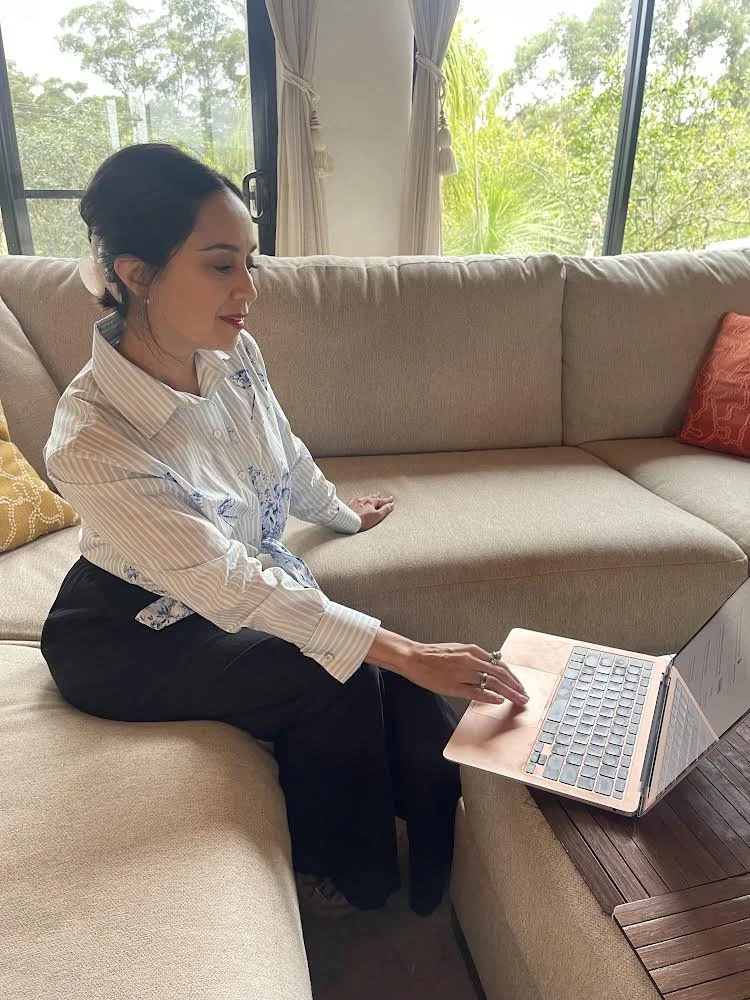
My business friends and I recently met for our quarterly Business Summit and there was one distinct topic we kept circling — AI.
Interestingly, I’m having more and more conversations with fellow agents and business owners that start with this question:
"Have you started using AI properly yet?"
Not just asking ChatGPT to write a social media caption or tidy up an email, but actually using artificial intelligence to build, improve and run parts of your business.
Because I think we're approaching a point where AI is going to fundamentally change the way small businesses operate, and for those of us working in real estate, I believe the opportunities are enormous.
As you know, I've always been interested in finding smarter, more efficient ways to work. Given I run a one-woman operation, it’s important I remain lean when it comes to overheads and expenses, so the growth of this new technology hasn’t frightened me. Rather, it’s excited me.
Having spent nearly three decades in the property industry, I've seen plenty of changes in how we market property, communicate with clients, generate leads and run our businesses, but I haven't seen anything quite like this. And while I certainly don't consider myself a technology expert, I've become increasingly interested in exploring what AI can actually do beyond the obvious.
In fact, it's becoming one of the tools I use most frequently in my own business.
I'm no longer just using AI to write content.
Like many people, I initially started using ChatGPT to help with my writing. I’ve always loved to write and share stories. Like my dad, I’m a natural at it, but lets be real. Tools like ChatGPT are elevating the writing game for so many.
Social media posts, article ideas, marketing copy, email responses and the occasional bit of brainstorming can all be supported by Chat, but this is merely scratching the surface when we stop and consider the full potential of AI for small business.
Over the past year, I've started looking at AI differently. Rather than treating it as a tool I occasionally open when I need help with something, I'm starting to think about how I can integrate it into the way my entire business operates.
Let’s look at marketing and content creation.
You and I can both agree that one of the biggest time-consuming aspects of running a personal brand is consistently creating content. Currently, I use AI to help develop article ideas, refine my writing, repurpose long-form articles into social media content, create LinkedIn posts and develop marketing material for my various business projects.
But there's an important distinction here.
I'm not asking AI to come up with my opinions or replace my experience. I'm using it to help communicate my ideas more efficiently. I can take an observation I've made during a property transaction, explore the psychology behind it, develop it into an article and then turn that article into several pieces of content for different platforms.
What might previously have taken me an entire afternoon can now be achieved in a fraction of the time.
I also use AI as a research and thinking tool.
Whether I'm exploring a new business idea, researching an industry trend, analysing a marketing strategy or trying to understand a new technology, AI allows me to explore information and ideas much faster. I can ask questions, challenge assumptions, compare approaches and work through different scenarios.
It's almost like having someone available to brainstorm with whenever I need them. And when you work alone, this is a godsend.
Of course, I still verify important information, particularly when it relates to property legislation, contracts, financial matters or market data. AI isn't infallible, and professional judgement remains essential, but as a research assistant, it's incredibly useful.
But here is where things start to get particularly interesting.
I'm currently exploring how to create an AI personal assistant that can help manage business communications and emails. Imagine having an assistant that understands your business, knows how you communicate, has access to your business processes and can help manage the constant flow of enquiries, correspondence and administrative tasks — all without the sick days, holiday leave and emotional dramas that come with humans.
Rather than starting from scratch every time an email arrives, an AI assistant could help categorise enquiries, prepare responses, identify important information, draft follow-ups and flag things requiring your attention.
The idea is to reduce the amount of time spent on repetitive communication and free up more time for the work that actually requires me.
For small businesses like mine, this is a game changer.
My recent business summit confirmed just how quickly things are changing.
When we all caught up, what really flagged my attention was how far everyone had progressed with it.
One friend has been using Claude to help re-build her website. The other has been developing AI personal assistants to support different areas of her business.
And these aren't software developers sitting behind computer screens all day. They're business owners just like you and I, identifying problems in their businesses and using AI to develop solutions. Think about that for a moment.
Previously, if you wanted a customised software program, an online platform or a specific business tool, you would generally need to engage a developer, invest considerable money and wait for someone else to build it. It’s an expensive exercise. Now, with tools such as Claude, people are experimenting with building their own websites, applications, automations and internal business systems with remarkably little technical knowledge.
I came away from that meeting thinking that we're only just scratching the surface.
What does this mean for real estate professionals?
I think real estate is an industry particularly well suited to AI.
It won’t replace us. It can’t. There’s too many moving parts that require human interaction but let’s stop and think for a moment about how much of an agent's working week is spent on repetitive tasks. This is where agents can win using AI.
Writing property descriptions, preparing marketing campaigns, responding to enquiries, following up buyers, researching suburbs, preparing vendor updates, creating social media content, organising databases and answering the same questions over and over again.
Imagine having AI assist with a significant portion of those activities.
Here are some practical ways you can start integrating AI into your business.
1. Create your own marketing assistant
Rather than asking AI to write individual posts, train it to understand your brand and marketing style.
Start by giving it information about:
Your target audience and ideal clients.
Your local market and areas of expertise.
Your brand personality and preferred tone of voice.
The services you offer and what differentiates you.
Examples of your previous marketing material.
You can then use it to help create property descriptions, campaign concepts, email newsletters, social media posts, buyer guides and vendor marketing material.
The more context you provide, the more useful the results become.
My advice is to spend time setting this up properly rather than treating every request as a brand-new conversation.
2. Build a social media content assistant
Consistency is one of the biggest challenges for agents. I know it is for me!
Between appointments, inspections, negotiations and client meetings, finding the time to plan and produce content can be difficult.
AI can help you develop a monthly content calendar based on your business objectives.
You could have it generate:
Weekly market commentary.
Educational posts for buyers and sellers.
Local suburb insights.
Frequently asked questions.
Video scripts and talking points.
LinkedIn articles.
Instagram carousel concepts.
You can even give it a single topic and ask it to develop five different pieces of content from that idea.
This is particularly useful if you're someone who has plenty of industry knowledge but struggles to turn it into consistent marketing.
3. Create a research assistant
Agents spend a considerable amount of time gathering information.
AI can help organise suburb research, summarise market reports, compare property features, identify relevant questions for due diligence and turn complicated information into something easier for clients to understand.
You could also build a research assistant that works from your own collection of market reports, suburb information, buyer resources and business documents.
The important thing is to ensure that information is current and verified against reliable sources.
Keep in mind, AI should help you interpret and organise information, not replace the research and due diligence required when advising clients.
4. Develop an email and communications assistant
This is one area where I think agents could save an enormous amount of time.
Imagine having an AI assistant that understands your business and can help you manage incoming correspondence.
You could use it to:
Draft responses to common buyer enquiries.
Prepare seller update emails.
Create follow-up messages after inspections.
Draft responses to prospective sellers.
Summarise lengthy email conversations.
Identify outstanding actions.
Prepare professional responses to difficult client situations.
You could even establish templates and workflows for different types of enquiries.
For example, when a prospective seller makes an enquiry, your assistant could help prepare an initial response, outline the information you need and suggest the next steps.
There are tools that allow AI to work alongside email platforms and other business applications, although you need to configure permissions carefully and maintain oversight of what is being sent.
This is all wonderful, but I would always keep a human review process for important client communications.
5. Build an internal business knowledge assistant
This is something I think many boutique agencies could benefit from.
Imagine having one place where your team can ask questions about your own business procedures, marketing processes, checklists, training material and systems.
Rather than searching through folders or asking the principal where something is, an employee could ask an AI assistant.
For example:
"What is our process for onboarding a new sales listing?"
"Can you find our checklist for preparing a property for photography?"
"What information do we need from a buyer before arranging an appointment?"
The assistant could draw on your own business documents and provide answers based on the processes you've established.
You don't need to be a technology expert to get started.
I’ll admit, I was sceptical to begin with. I’m usually the last person to adopt new technologies, mainly because I’m terrified of them. But the truth is, you don't need to understand how software is coded or know how to build an application from scratch to start reaping the benefits of AI.
What you do need is an understanding of your business, the problems you're trying to solve and the ability to clearly explain what you want AI to help you achieve.
In fact, I think having strong business knowledge is becoming even more valuable.
AI can generate information, write content and help build tools, but it doesn't automatically understand what makes a good real estate agent, how to negotiate effectively, what creates trust with a client or why one business strategy is better than another.
That's where your experience comes in.
The better you understand your business, the better you can direct the technology.
If I were starting from scratch, I'd approach it in three stages.
Step one: Identify your biggest time wasters.
Look at your working week and identify the tasks that are repetitive, administrative or unnecessarily time-consuming. Don't start by trying to automate everything. Choose one or two areas where you could make an immediate difference.
Step two: Create dedicated AI assistants.
Start using a tool such as ChatGPT or Claude and give it the information it needs to understand your business. Rather than having one general conversation for everything, create dedicated assistants for specific functions such as marketing, research, administration or client communications.
Give each one clear instructions, examples of your preferred outputs and relevant business information.
Step three: Explore automation and integrations.
Once you've established where AI can help, start looking at ways to connect it with the applications you already use. This might include your email platform, calendar, CRM, website or document management system. The objective is to create a more connected business where information and tasks can move between systems with less manual input.
Just remember that client information, privacy, data security and professional obligations need to be considered before connecting any external AI tool to your business systems.
The real opportunity isn't just saving time. It's changing what a boutique business can achieve.
This is probably the part of AI that interests me most.
For years, running a successful business has often meant building a team, outsourcing specialised work and investing in expensive systems.
If you wanted a website, you hired a web developer. If you needed marketing support, you engaged a marketing agency. If you wanted customised software, you paid someone to build it.
And while those services still have an important place, AI is changing the economics of what a small business can do independently, and this is what excites me the most.
A business owner can now experiment with ideas that previously would have been too expensive or complicated to pursue. You can develop your own resources, build internal tools, create customised assistants and improve processes without necessarily needing to employ someone for every function.
For independent agents and boutique agencies, this is something you should find the time to explore.
It means you can potentially operate with greater efficiency, offer a better client experience and compete with larger agencies that have considerably more resources.
Don't lose the human element.
At it’s core, real estate is a people business. We can never overlook this, nor should we.
As you and I know, buying and selling property involves significant financial decisions, emotions, relationships, trust and, quite often, a fair amount of negotiation.
AI can help us become more efficient, but it cannot replace the experience, judgement and interpersonal skills that make someone genuinely good at their job.
It can help you prepare for a negotiation, but it cannot take responsibility for your decisions.
It can draft a thoughtful email, but it doesn't necessarily understand the relationship behind the conversation.
It can analyse information, but it doesn't automatically know which information matters most.
I see AI as an incredibly capable assistant, not a replacement for professional expertise — and perhaps that's the most important distinction.
The agents who will benefit most from this technology won't necessarily be those who use the most AI. They'll be those who know how to combine it with their own experience and judgement.
My advice? Start experimenting now.
I genuinely believe we're at the beginning of a significant shift in how boutique agencies operate, and if there's one thing I've learnt from nearly three decades in real estate, it's that the industry doesn't stand still.
The way we communicate, market, transact and operate will continue to evolve. The agents who remain curious, adaptable and willing to learn will be much better positioned to take advantage of those changes.
You don't need to become an AI expert overnight. Start small like I did, and experiment. I’m still playing around with this technology and learning new things every other day. In fact, I'm probably more interested in the possibilities now than ever before. Because we don’t necessarily need to learn AI to be better agents. We need to see it as an opportunity to rethink how we run our businesses.
And for small business owners, I think that's a very exciting place to be.
Explore my programs.

An intentional self-discovery for ambitious women ready to refine their professional presence, strengthen their financial future, and redefine what's possible in their career.

ENROLLING JANUARY 2027
ENROLLING JANUARY 2027
Become a sought after Buyer's Agent and build a high-trust, high-fee advocacy business defined by expertise rather than volume.
